
Expedia Group
Reimagining analytics - from internal
jargon to partner language
Rebuilding Expedia Group's hotel analytics product from the ground up. Auditing 50+ screens of indecipherable data, reimagining the information architecture around partner mental models, and creating a scalable content system that outlived the project itself.
The problem
Expedia's analytics tools for hotels provided a lot of useful data, but it was sparsely and inconsistently designed, confusing to navigate, and leaned heavily on internal jargon.
Analytics for partners
Hotels that list with Expedia Group have access to the Analytics product, which provides plenty of numbers around how they were performing on our sites.
However, the experience had accumulated years of internal jargon, fragmented navigation, data without context, and tech debt.
Partners struggled to find what they needed, were suspicious of what they did see, and spent hours manually cross-checking Expedia's data with their own sources.
What 18 partner interviews revealed
We discovered that level of engagement with Expedia and ambition influenced partner's relationship with analytics and were more consequential than market segment. This reframed how we thought about content and information architecture entirely.
In other words, we needed to tell a story.
The goal
Create a modern, usable, and insightful data platform to help our partners understand their market and identify opportunities to help their business.
How did partners actually use analytics?
We mapped the most prominent use cases of our partners. These were the three categories we used to define how we were going to group each piece of data, design it, and then communicate it.
The existing navigation had over a dozen labels that used Expedia's internal terminology, which led to a confusing and unpredictable experience for partners.
I redesigned the information architecture to match how partners actually think about their business. This would serve as the map for our new flow.
We simplified the partner's mental model to a basic flow.
Next, I set out to define the labrynth of words that made up the Analytics space.
I went about defining each one to be accessible, relevant, and free of jargon that could confuse our more casual partners (ie, mom-and-pop bed and breakfast owners).
But I had an ace in the hole: market managers. They talk to partners every single day and are responsible for maintaining a business relationship with them, so they hear about everything.
So I recruited the front line to give feedback on the terms we use most often in the Analytics space.
To ensure that the content was leading back to our partners' core needs, I documented each data point, assigned them a content type, and then placed them in one of the partner needs categories: monitor, deep dive, and/or report.
I used this as a framework for mapping where each specific data point belonged in the flow.
The solution
A one-stop location where the partner could easily guage their performance, view personalized recommendations, and see how their actions are affecting their overall performance with Expedia. From raw numbers to narrative.
Monitoring performance
Partners said that they wanted an easy, intuitive way to understand how they were performing. So we designed a simple conversion graph with simplified language so they could quickly check the pulse of their overall performance.
This is the first page they saw when navigating to the Analytics page.
Identifying opportunities
To make the Analytics space more actionable, we had the data science team identify opportunities that a partner could take to improve their performance.
I defined the parameters for each opportunity, wrote descriptive cards for each with proof points specific to that property, and documented them.
Clear results
And finally, I documented three variations for each opportunity, depending on whether the result was positive, neutral, or negative.
If the result was positive, I wanted to congratulate them on their success. If neutral or negative, I suggested that they either stay the course or take additional actions to turn the ship around.
And this is how it all came together...
The impact
The new analytics experience put the partner's story front and center. Now we lead with revenue and key metrics anchored to their main competitors, and proactively surface opportunities, giving partners a clear path from insight to action.
100%
Partner approval in testing
Every partner who tested the redesigned experience much preferred the new design, citing the new content strategy by grounding the data in the three partner modes identified in generative research.
$120M
Revenue in year one
After implementation, the cumulative effect of the new design across the entire platform contributed to $120M in revenue and a 10.2% increase in market penetration, drawing a clear connection between between content and partner engagement and action.
70k
Partners reached
My content strategy for Analytics touched nearly every experience in Partner Central, reaching over 70,000 hotel partners. This new strategy came to define how all partners interacted with their data throughout the entire platform, whether they were on the Analytics page or not.
What our partners had to say

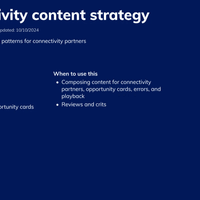
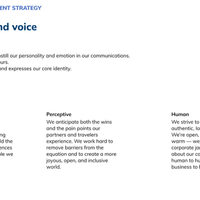
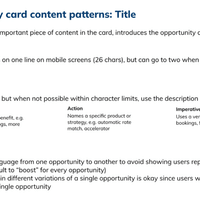
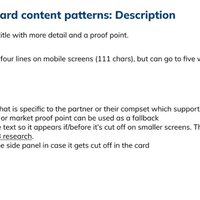
Not only did we redesign the Analytics space, I also created the entire content strategy that other design teams could use for incorporating data content in their own product areas.
This is a snippet of the strategy that I shared with the other teams.
Why it matters
The Analytics redesign is a case study in content design influencing an entire system.
The immediate deliverable was a cleaner analytics product. The real output, however, was a reusable framework for how Expedia Group communicates data to partners. That output found life outside of the Analytics space and impacted all of our partner products.
What I learned
This project taught me that a content audit is as much a strategic document as a tactical one. We should catalogue what's broken, but the focus should be in identifying the pattern behind the breaks, so you can fix the system rather than the symptoms.
It also reinforced the value of research as a content brief. The three partner modes (monitoring, deep diving, reporting) gave me a framework for every IA and copy decision for the rest of the project. When you're unsure whether a metric belongs on an overview page or deeper in the flow, "what mode is the partner in right now?" provides a quick answer.
And building for scale meant accepting that some of the most important work would be invisible. Many of the principles that I outlined prevented hastily decided and inconsistent content decisions being made downstream, long after I'd moved on to other products.
Let's work together
Chicago, IL


